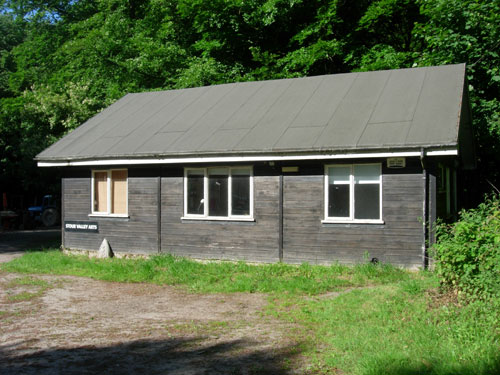
At the beginning of June I spent a week in a little forest studio at the edge of King’s Wood in Kent. The idea was to take some time out to experience the wood at dawn, dusk and day, time to get inspiration for the book I’m writing. I was doing another mini immersion in nature.
The Forest Studio
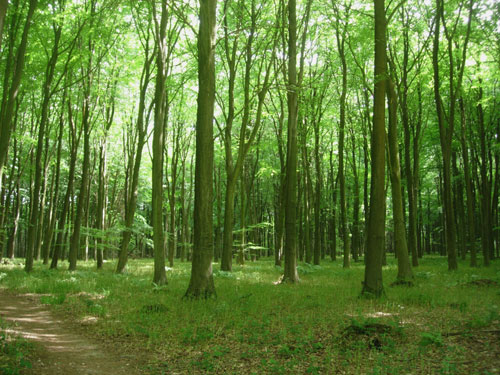
I spent some time wandering in the nearby beech wood plantation, listening to the silence or gentle moan of the wind through the branches. It was like being within a giant underwater forest:
Beech Wood Plantation
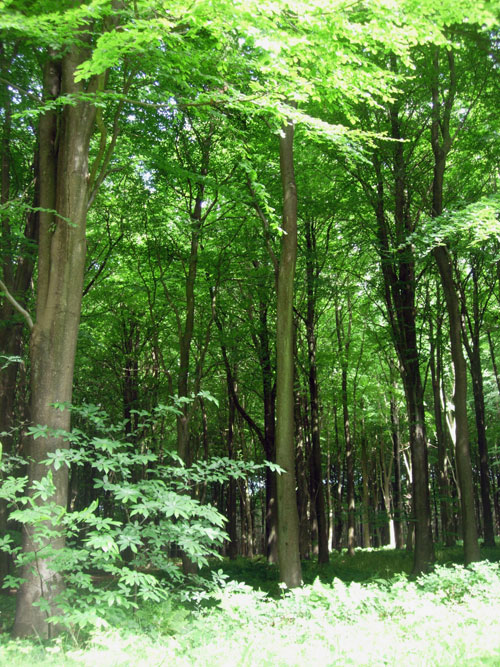
There was such a contrast between the dark interior and the light exterior:
Edge of the Beech Wood
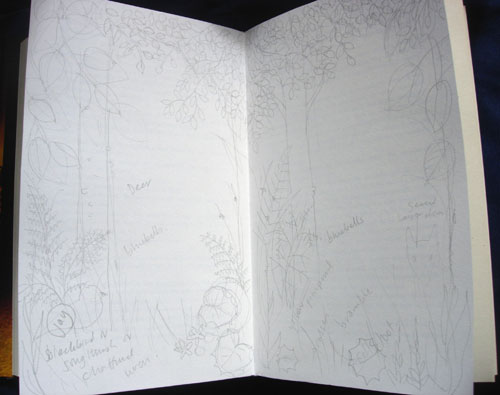
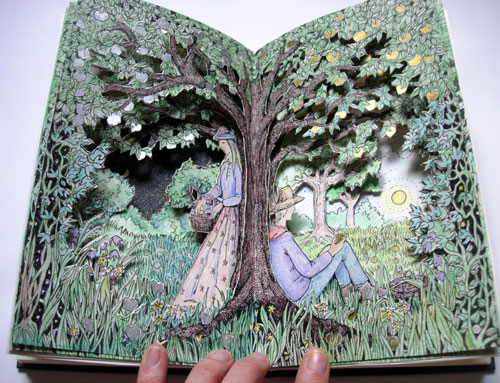
Wandering and looking at the beech wood trees made me think about the way I create woodland and tree altered books. So I have been making an “In the Beech Wood” altered book:
The Start of an Altered BookBeech Wood Altered Book
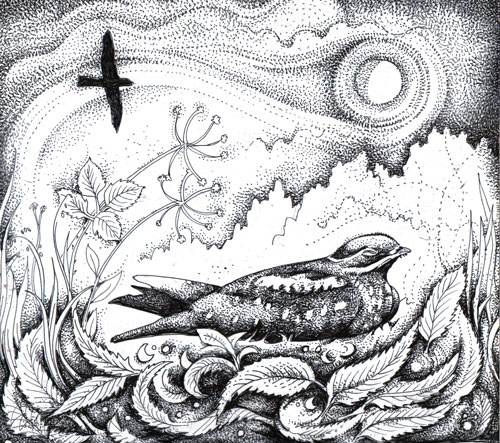
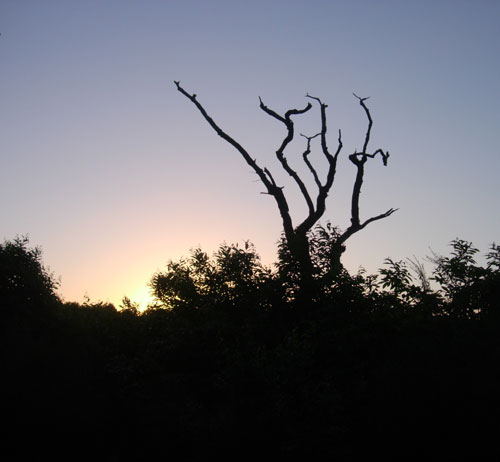
At dusk I went out to see if I could see nightjars in the chestnut coppiced area. I was lucky. For several evenings I heard their uncanny churring song and saw the dark shape of the males flying against the sky clapping their wings as they do to display to the female or ward off any other males encroaching on their territory. They were too fast and it was too dark to photograph them but I can picture them in my mind’s eye.
Nightjar
Nightjars are mysterious birds, birds which have attracted superstition and folklore down the ages. They’ve had many names including the name ‘goatsucker’, which stems from their Latin name Caprimulgus which means to milk nanny goats. The myth arose as nightjars were drawn to the insects surrounding livestock.
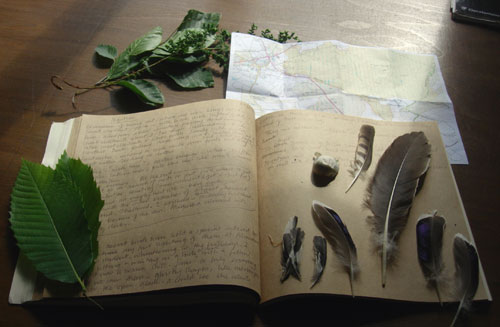
Dusk Night Dawn Writing Book
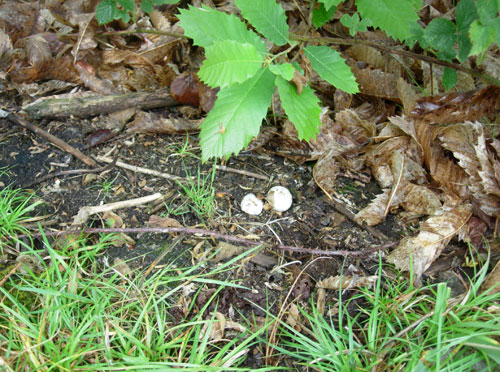
I wandered into the chestnut coppice by day getting to know nighjar territory and was surprised to find an old nest site with a couple of hatched eggshells!
They were close by, perhaps watching us through the trees, through the dim blue morning twilight – bears!
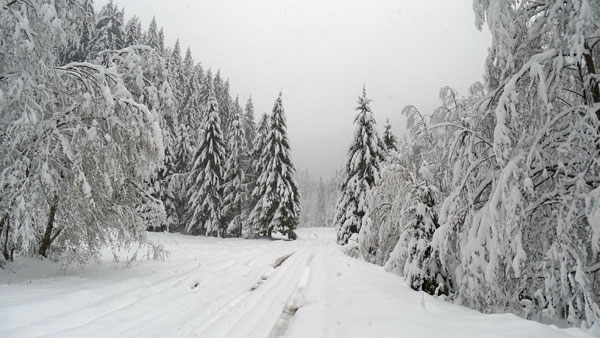
On the first morning we set off early, leaving our hostel at 5.30am. The streets were dark and wet with snow piled up the kerbs and covering the pavements in the town of Zarnesti. Romania was experiencing freak April weather – below zero temperatures and snowfall. Ramon, our expert guide and tracker, drove quickly and effortlessly into the white landscape on the edge of Piatra Mare Mountains, winter tyres proving their worth.
The bears had returned to their dens – so we searched for wolves instead as wolves don’t mind the cold and snow. But the blanketed slopes and meadows were empty.
Snowy Scene – by Jurj Ramon
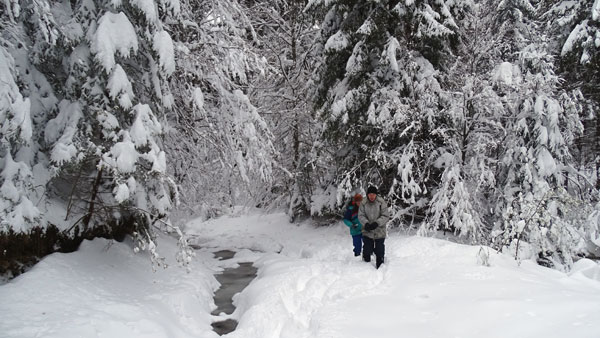
Come dusk we went out again. The temperature was minus 4 and the breeze was coming from the north so Ramon took us up the side of the valley into the forest to stay downwind. The snow was two feet thick in places and as we walked in single file, I stepped in the footprints of Ramon and Kevin who were ahead of me. This made it easier to walk. Every-so-often Ramon pointed out tracks – a trough in the snow where bears had dragged their bellies or the arched prints of red deer.
We came to a stream, a dark, trickling ribbon flowing through banks of snow and beneath omenous windows of ice.
Snowy River – by Jurj Ramon
Then the valley slopes steepened and we climbed a snowy corridor up through the trees – Norway spruce, beech and silver birch. My heart felt as if it would burst with the exertion as I sweated beneath my numerous coats and jumpers. At last we reached a viewpoint from where we could see the opposite side of the valley, a rock ridge of mountain with a belt of forest on it’s lower slopes above open fields of snow. There we waited and watched, waited and watched scanning the fields with binoculars or with just the naked eye.
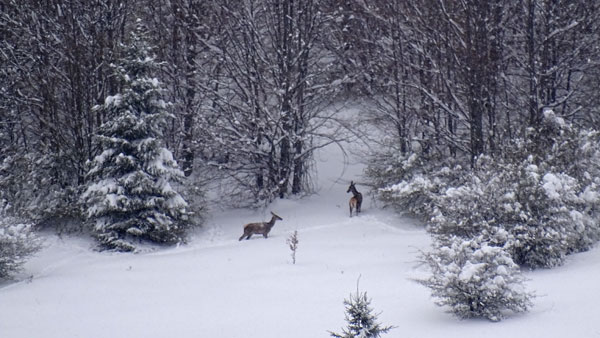
Some animal was moving on the edge of the trees far off. It was not a bear but a red deer, identifiable by its fawn rump. Then we saw three of them. One kept a lookout while the others browsed on tree buds. I have only glimpsed red deer in Scotland so it was good to see them.
Red Deer in the Snow – by Jurj Ramon
On our way back down we saw fresh tracks of a family of boar that had crossed our own. We looked about and listened but the animals themselves remained elusive. Further on Ramon stopped and whispered that a bear was close by; there was a change in the smell of the forest and even I noticed a slight hint of animal nearby – not like fox, but a dense, animal smell.
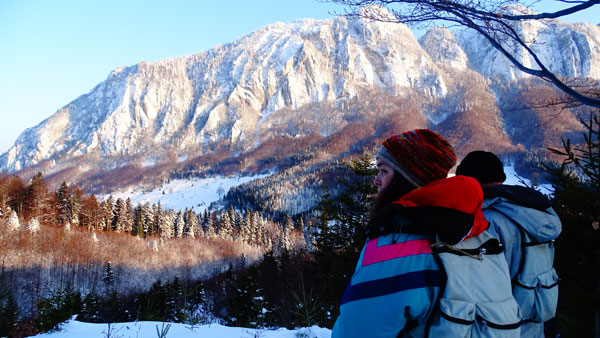
On our second morning we returned to our valley viewpoint. Dawn broke with a wonderful rosy light illuminating the mountain before us. The air was crisp, cold and clear. Ramon pointed out a scratched triangle of trees, the territory of the only lynx in the valley.
Dawn over the Postavarul Mountains – by Jurj Ramon.
Up the hillside again Ramon noticed fresh bear tracks disappearing into an enclave of rocks and bushes. He said that he saw a bear there and told us to move further down the slope as a bear cornered in the area could be dangerous. Earlier he had told us that a bear on its hind legs was looking about to assess the situation. A bear crouching close to the ground was a dangerous bear, an animal ready to charge. We trusted he knew what he was doing as he’d spent years tracking and researching bear behaviour. From a distance Ramon clapped in the hope that the bear would show itself, but no bear emerged.
Wildlife was so close and nowhere to be seen; it was as though the bears were teasing us. The snowy hillside remained full of their presence and absence at the same time. Despite not seeing bears it was a wonderful experience being out in the snowy wilds at dawn and dusk and knowing that we were so close to some of the top predators in Europe.
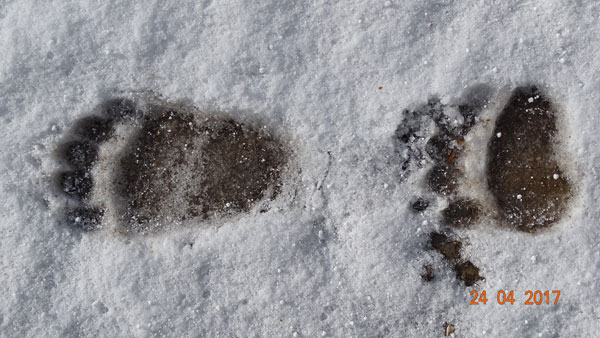
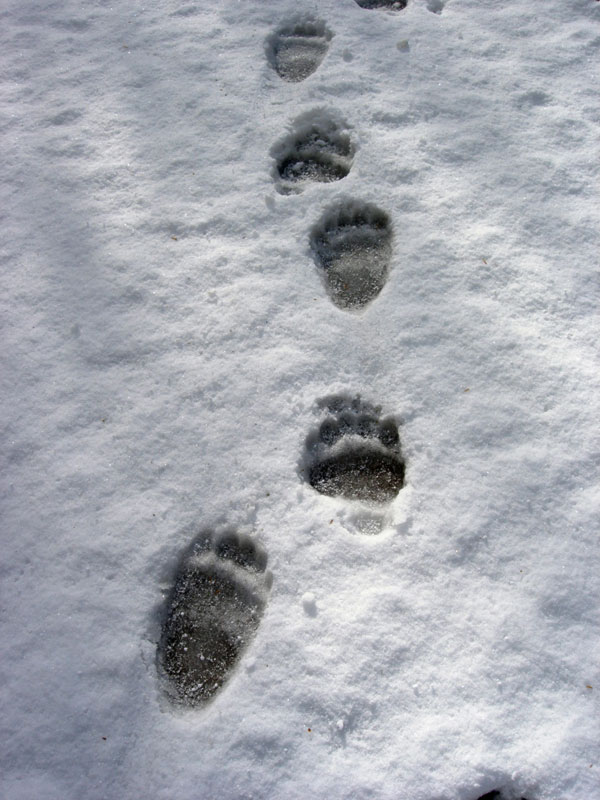
Bear Back and Fore Prints – by Jurj Ramon.Bear Tracks – by Alexi Francis
The photos above – apart from the last – were taken by our bear tracker and expert, Jurj Ramon.
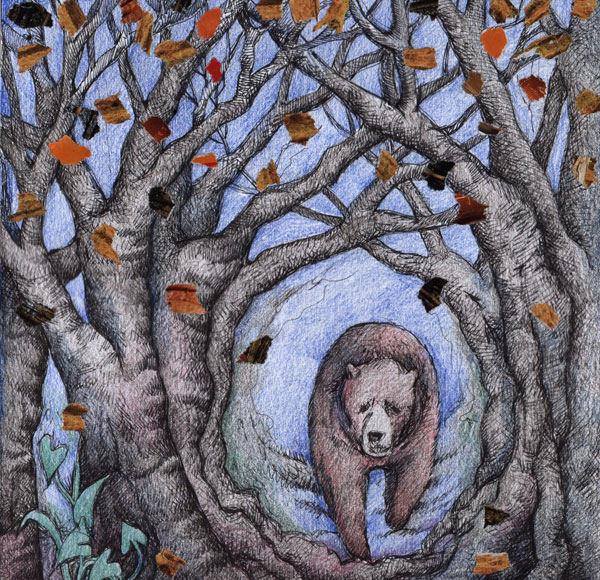
I can’t help thinking about Spirit bears. I’ve drawn a bear image. Perhaps this is a Spirit Bear drawn to evoke the wild bears when we return to Romania in the future.
I’m very into natural sound recordings and came across Be:One last year. It was created to accompany The Hive installation. The Hive was an installation by artist Wolfgang Buttress at Kew Gardens last year.
“An open-air structure standing at 17 metres tall and weighing in at 40 tonnes, The Hive encapsulates the story of the honey bee and the important role of pollination in feeding the planet, through an immersive sound and visual experience.”
Here’s a video about the soundscape:
There’s something hypnotic about the bees’ droning.
In the Ancient Greek world bees were worshipped as they represented a link between our world and the underworld. There were special priestesses refered to as “bees” or “Melissas”, the Greek word for honey bee. In Ancient Greek myth Melissa was a nymph who nursed the baby Zeus, feeding him honey instead of milk. It was from her that the cultivation of bees for honey was supposed to have come.
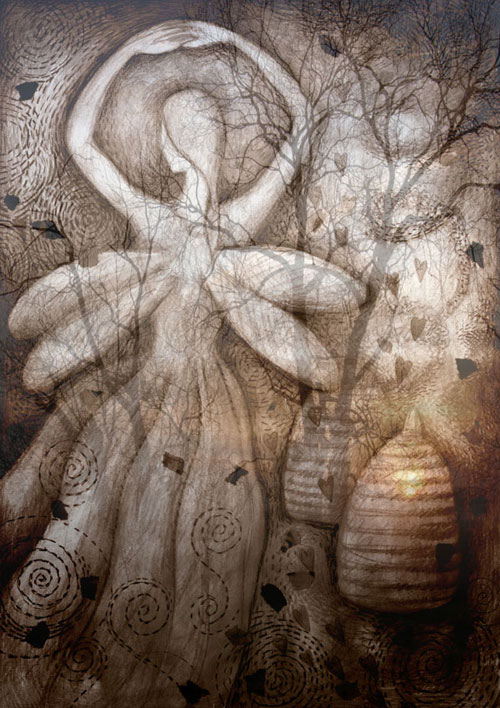
I’ve worked on a Bee Goddess illustration with this ancient bee nymph in mind. I’ve now made it into a card available in my Folksy and Etsy shops.
Bee Goddess
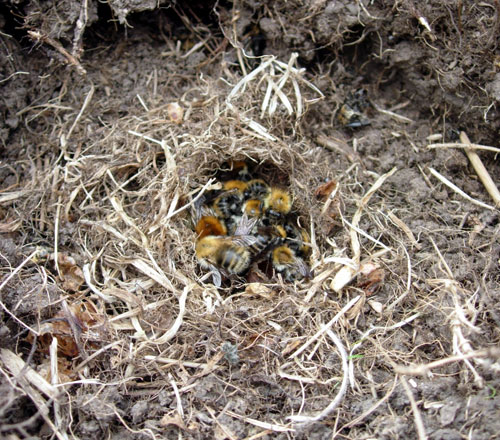
Since February I’ve been noticing many large bumbee bees while out walking. They’re queen bees seeking nesting sites. I came across a carder bee nest one summer which I was a little wary of but it was also quite charming like any nest!
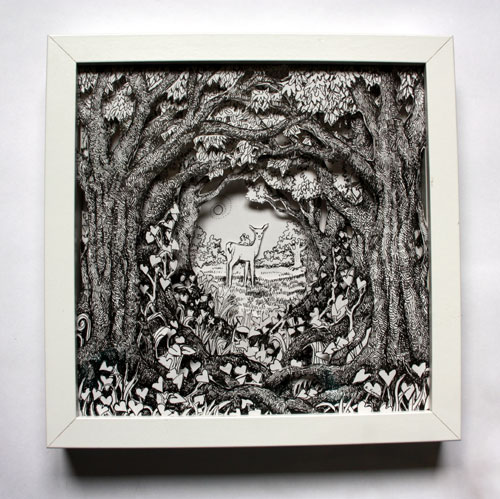
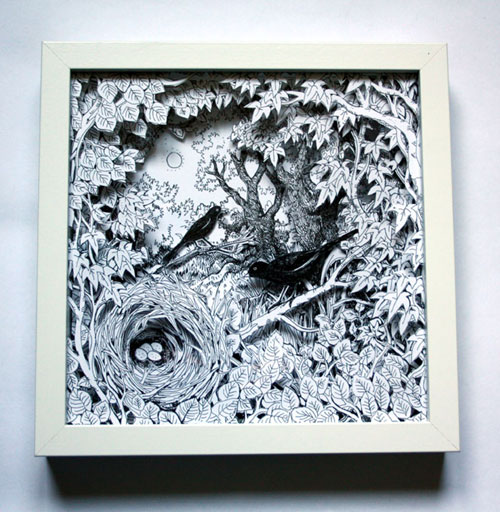
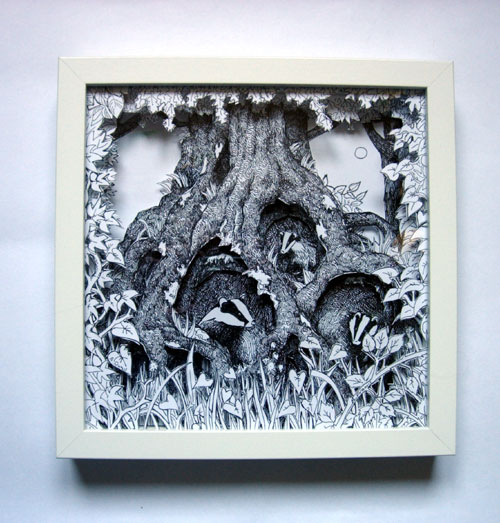
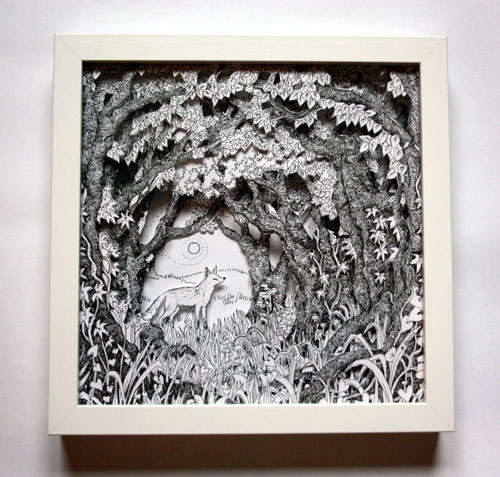
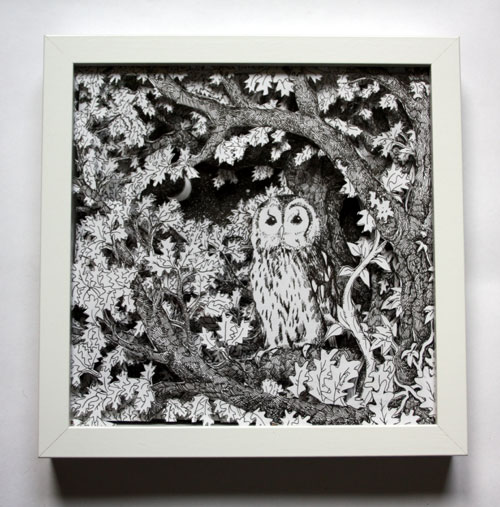
It started with my neighbour having a clear out and leaving a pile of white box frames on the wall outside my house (it’s common for people to leave stuff on the pavement with a note saying “Free, please take me!”). The box frames were in excellent condition and I had an idea of creating a layered illustration inside one similar to the way I make altered books.
My first attempt was of a deer in a glade. I took it to Studio 45, a little gallery near the Open Market in Brighton, where it promptly sold. I created more layered illustrated papercuts and bought some more box frames to continue the project. Those I’ve completed so far can be seen below. Some have gone to good homes, some are for sale in my Etsy Shop and Folksy shop and a couple are in galleries. They reflect my current themes of woodland, woodland edges and the wildlife that lives there.
Deer in the Glade Box FrameBlackbird Nest Box FrameEmerging at Dusk Box Frame – badgers!At the Woodland Edge Box Frame – fox!Owl at Dusk Box Frame
I am creating a separate page for box frames in the same way I’ve created a page for altered books. I’m still very much into pen and ink but soon I’ll get into colouring again.
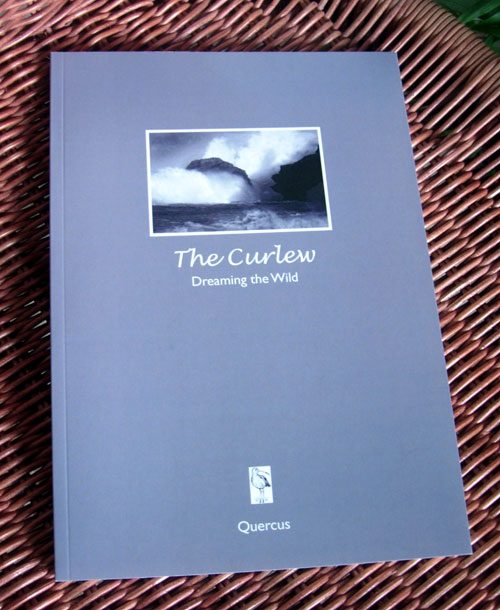
I’m just writing a brief post to spread the word about a new literary journal, The Curlew, in which I have an essay and some artwork.
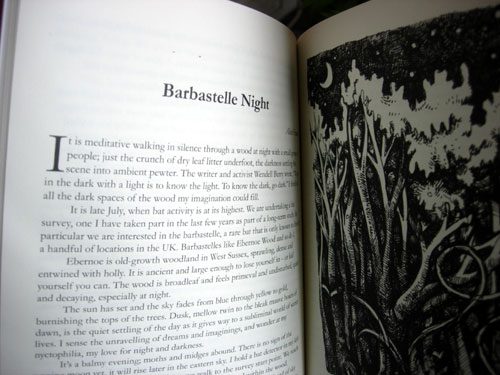
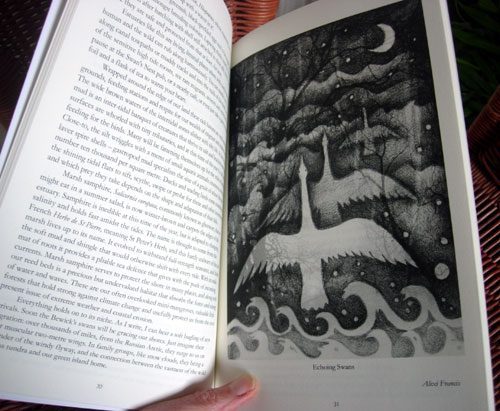
I was very pleased to have my essay accepted. It’s about a bat survey I took part in at Ebernoe Common woods in the summer. My image, Echoing Swans and a pen and ink illustration of a dark wood also feature.
The Curlew literary journal.My essay about bats in The Curlew.Echoing Swans in The Curlew
The Curlew donates to wildlife charities such as Cheetah Conservation Fund and The Born Free Foundation and is looking for contributions of creative non-fiction, poetry, artwork and photography. It’s also keen to involve young people with a special section called “Sanderlings”.
I thought I’d document the process of making an altered book – my way!
Below are photo’s showing the process of making The Edge of the Wood altered book.
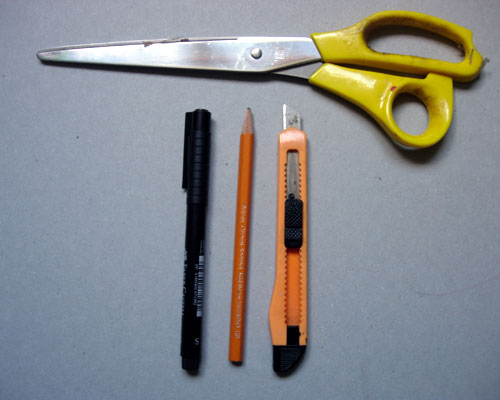
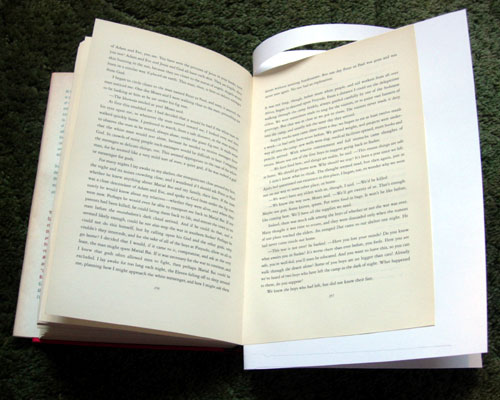
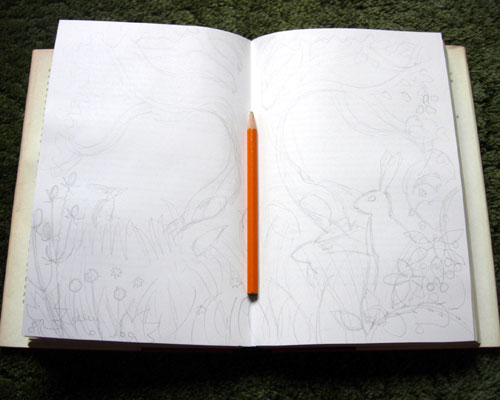
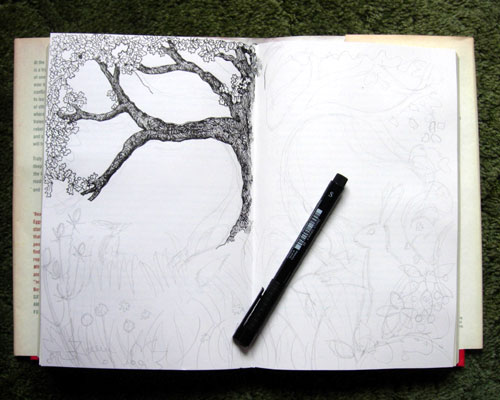
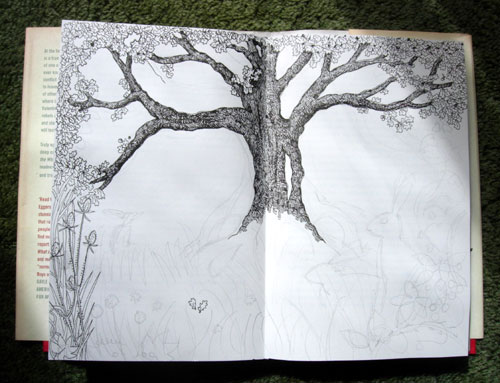
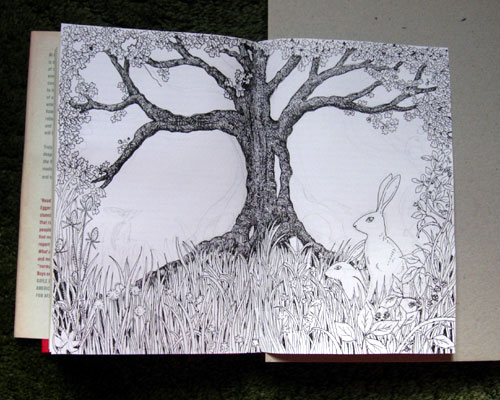
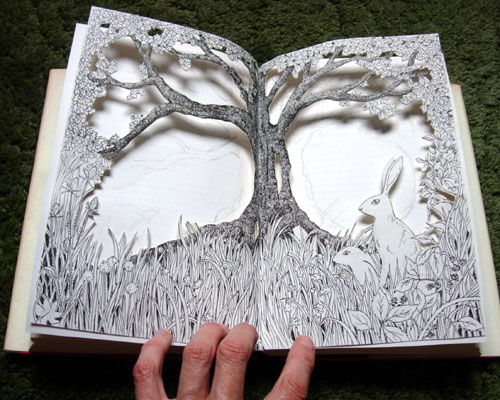
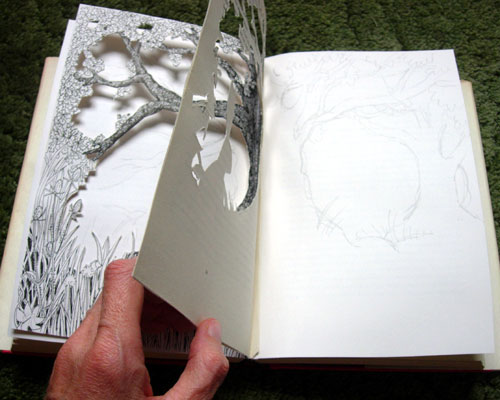
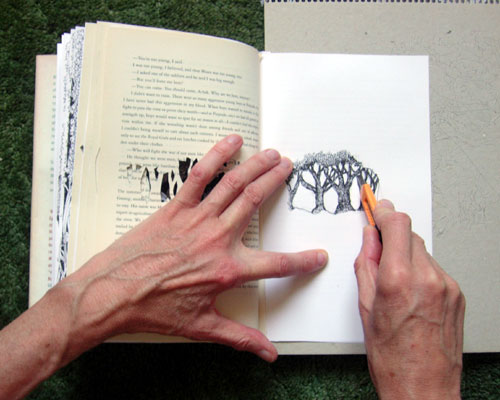
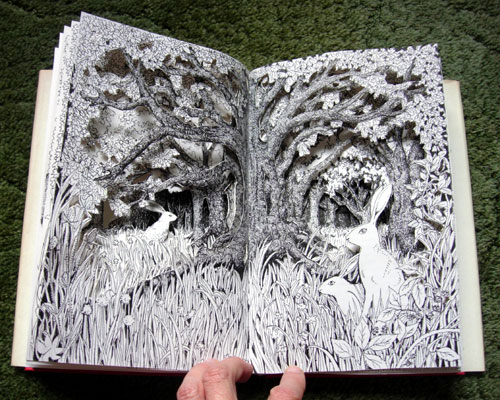
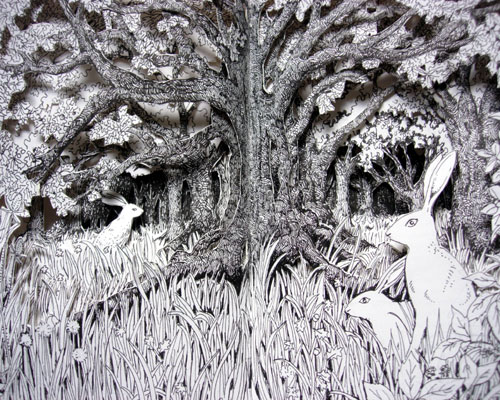
I start with a hardbacked second-hand book from a charity shop or found in the street.My tools – scissors, a pencil and a cutting knife. Also needed are a glue stick, a piece of cardboard and white cartridge paper!I open the book roughly in the centre and glue a piece of cartridge paper across both sides with a glue stick.Showing the paper stuck in and the edges to be trimmed.I sketch out the top picture in pencil that I’ll later rub out.I start drawing. I use a Faber Castell, PITT artist pen, size smallDrawing underway. I love drawing trees and like putting a tree centrally to span both sides but there’s plenty of scope for other arrangements.The top picture finished. Place board beneath drawing ready for cutting.Showing cutaway pages with a new sheet of cartridge paper stuck beneath each side.Showing beneath cutaway page.Cutting the second-from-last page.Here is the finished altered book that I’m calling” The Edge of the Wood.” At this stage I might add a bit of colour with watercolour pencils and/or inks.Here is a close-up detail of “The Edge of the Wood.”
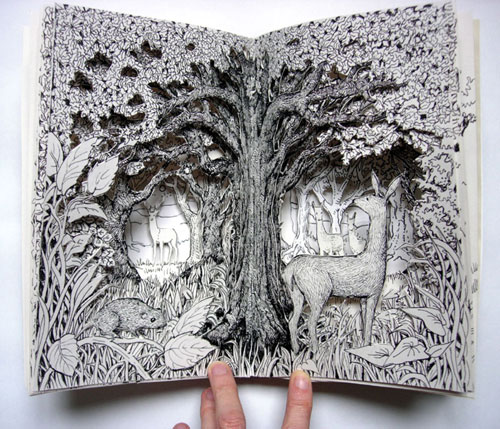
The Edge of the Wood and Deer in the Forest below will soon be on display in Avocet Gallery in Rye.
Silver Apples Golden Apples Altered Book with a bit of colour
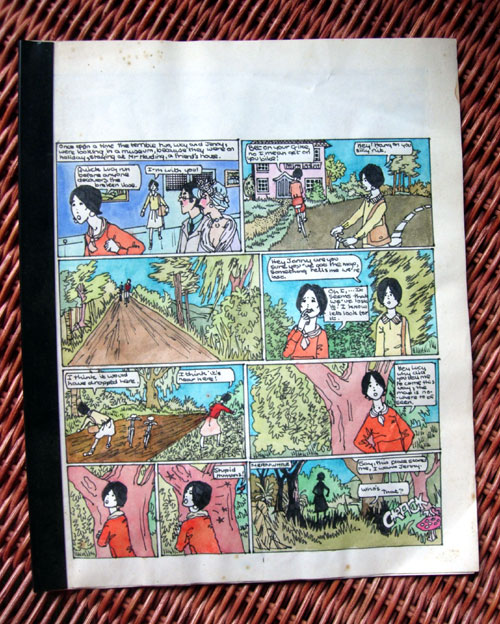
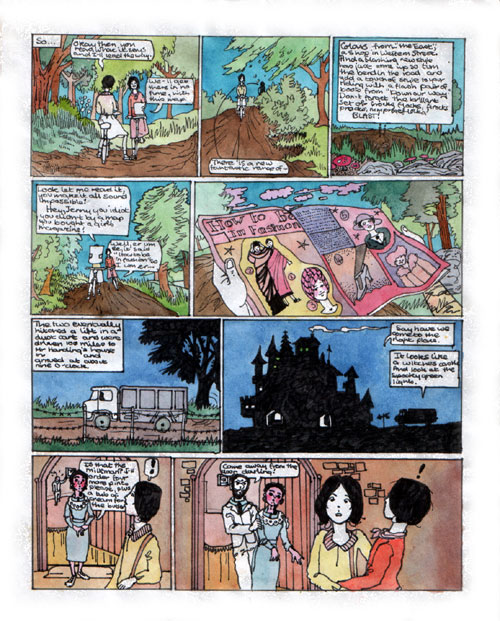
While colouring it in with watercolour pencils I was reminded of creating comic strip pages when I was a child. I dug them out the other day and read them with amusement. I’ve no idea what the story is about but I know I liked comics as a child and was inspired by the Tintin books that my brother had. These comic pages must have been done when I was about ten or eleven but there’s no date on them.
Handmade Comic Strip made in the 70s.A Page of a Picture Story I made as a Child
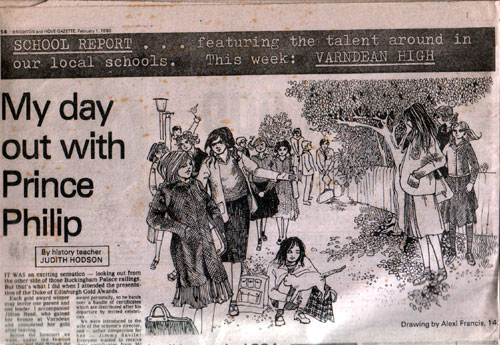
I also discovered an old Brighton and Hove Gazette newspaper in which I had one of my drawings. It’s not that great, but could I have done any better at fourteen?! By the way, I didn’t have a day out with Prince Philip that was my history teacher! :)
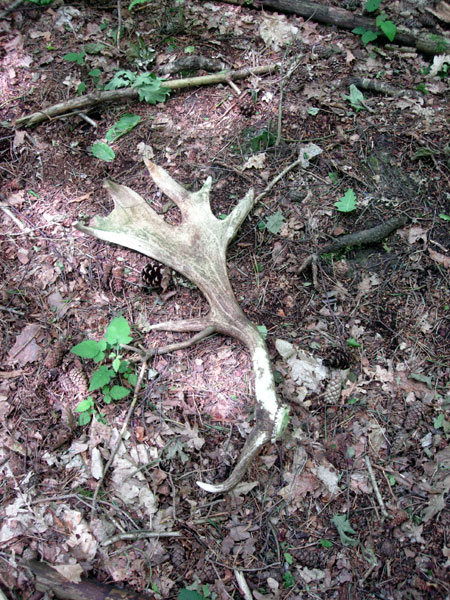
Deer. Signs of their presense, torn bark, a trail of hoof prints through the trees, a shed antler. Deer are elusive, highly tuned to the slightest sound or movement; a delight to come across.
It is easy to understand how deer are often seen as magical creatures in myths and stories, connected with the spiritual, supernatural world. Often in these stories and myths they are white, a brilliant, glowing white. In Celtic mythology, they are seen as ‘fairy cattle’ that are milked by mystical women – sometimes banshees – who themselves shapeshift into deer. I am fascinated by shapeshifting in any form and by the crossing of the subtle veil between worlds.
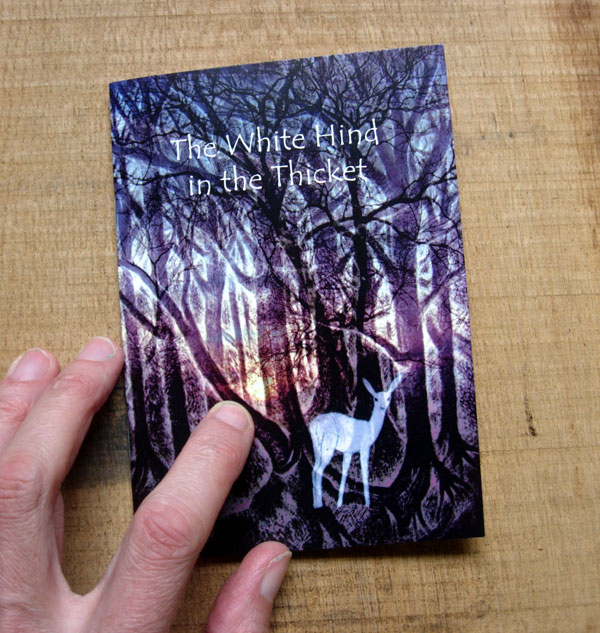
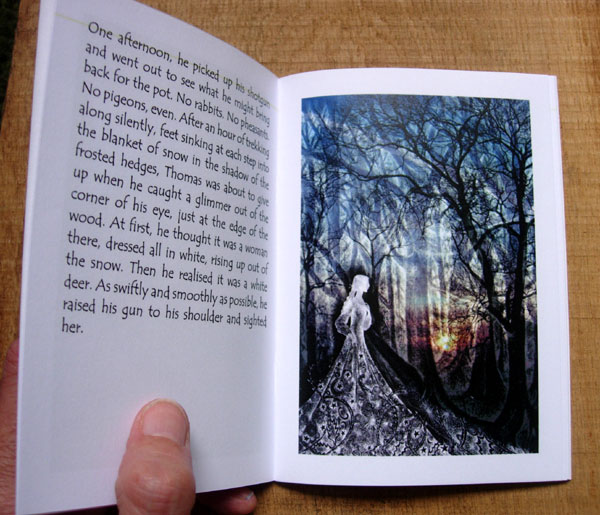
I have been collaborating with the author and storyteller Roselle Angwin. Once I had written my book, The Memory Tree, Roselle proof-read it. She liked my artwork and suggested that we work on something together; I would illustrate one of her stories. As she lives close to Dartmoor, she chose an old Dartmoor tale that she first heard from Dartmoor storyteller, Mavis Hewitt. The story is about a man’s encounter with a magical deer. Stories with this theme occur all over Europe.
Here are some photos of our booklet fresh from the printer. It is available in my Folksy shop and in my shop on this website.
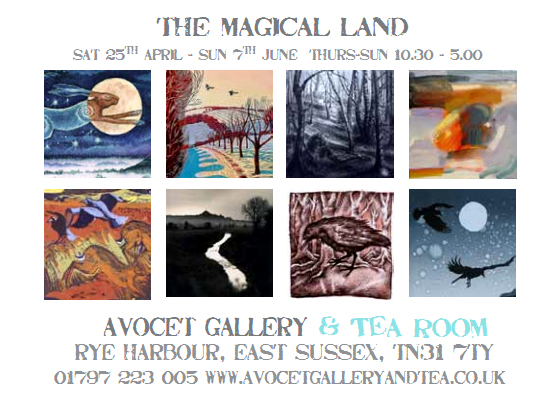
Avocet Gallery in Rye is currently holding The Magical Land exhibition and I am very pleased to have some of my work on show as part of it.
Here are a few of my illustrations in the exhibition:
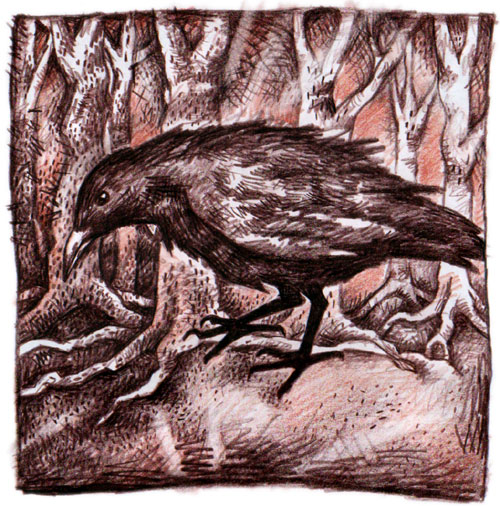
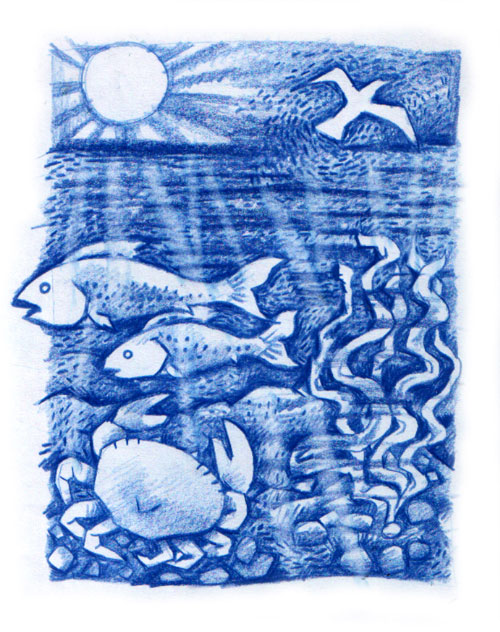
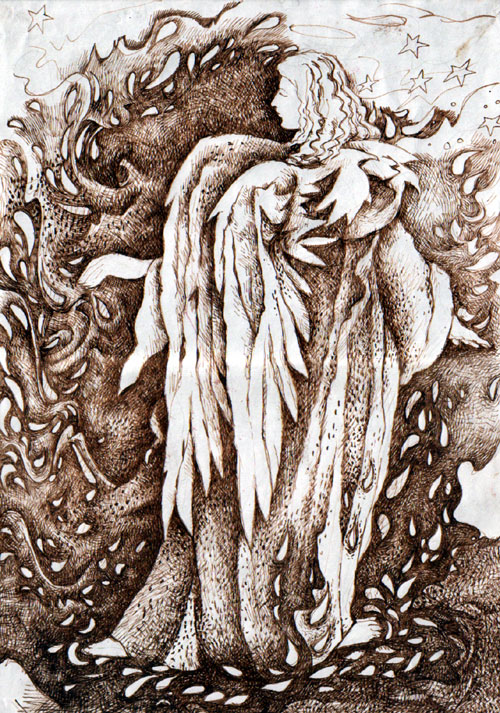
The Crow in watercolour pencil. Drawn for The Crow, a folktale by Christopher Meckel – see my The Crow page.Blue Sea Scene in watercolour pencil.Angel in pen and ink.
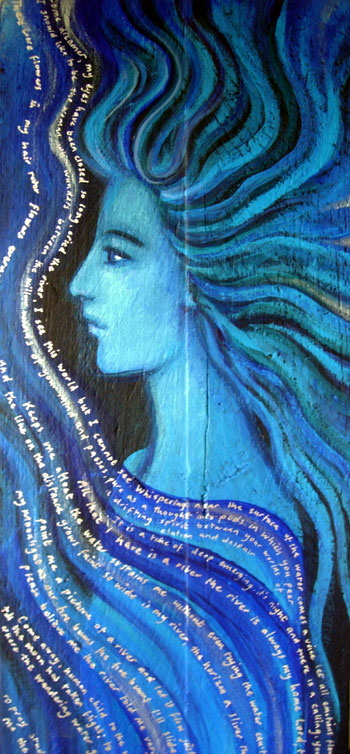
Along with the illustrations are cards and two of my long painted boards. One is very much a river goddess board as it is covered with flowing lines of lyrics, poems and words about rivers.
Come dreamer,
my eyes have been closed so long, cried the river
I see this world but I cannot see
whispering near the surface of the water comes a voice
let all emotions flow from our dreaming together
I am afraid to heal my soul, said the river
then your spirit connected to mine will die
whispered the wind
do not hide from me river, find your ocean
if you listen deeply
wind and river coming together as one
in the great ocean we’re born of the mother.
This is the way she hears your voice now, all of your feeling
easy or difficult,
truthful ones,
do not be afraid
all the rivers are dying
I will open my eyes to see inside
so my soul whispers with the wind.
Take a deep breath…
Words taken from a YouTube video by Condor Shaman that is no longer available.
Back in March I took two painted boards to Herstmonceux Castle for Waterweek as I had been invited to contribute some creation. When I took them in on the second evening, one of the artist organisers looked as though to say what on earth have you brought us! I left hurriedly without attending the evening talks, embarassed as I am about these things and made off into the night across the misty Pevensey Levels. I had dared to show something, I had taken the risk! I didn’t see any of the week’s events as I desperately needed to escape the clamour of Brighton and spend the week cosied up beside a roaring woodburner in a shepherd’s hut down in Dorset.
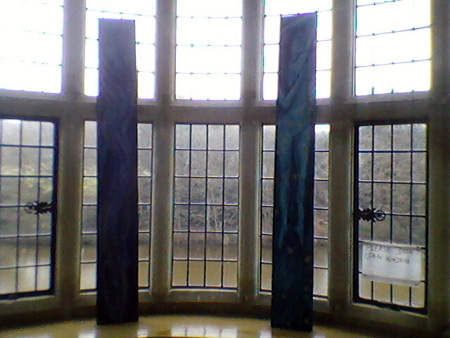
When I returned to pick up my boards, we – Kevin and I – were taken up through the castle corridors and shiny-floored halls to a main room by a friendly caretaker who knew all about my boards. And there they were placed up in a bay window which I thought was a lovely prominant position.
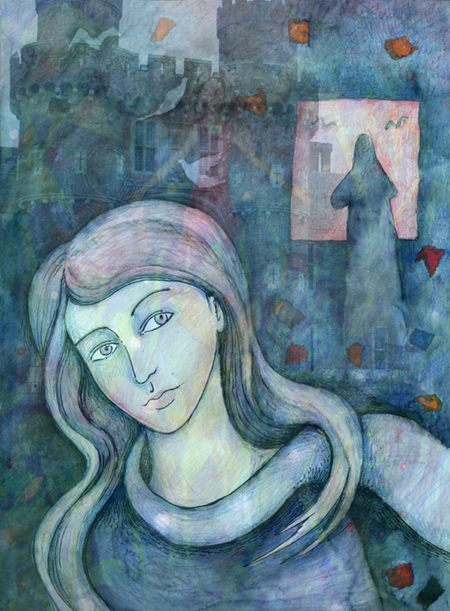
Why I’m writing this is that I’ve recently had a dream about Herstmonceux Castle. It is perhaps strange that of all the wonderful things that happened that week, all I can write about is my dingy dream. But the castle definitely made an impression on me.
My dream:
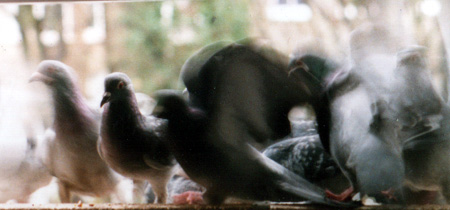
I was at Herstmonceux Castle working on my Memory Tree story in a library there. From the windows I could see the fresh green growth of the trees. I was with my mother who was lingering and wasting time when I wanted to go into town with her. I decided to leave her but felt torn. I have many images of her beside a window, sunset without, feeding the birds.
Life is rich on deeper levels. I reach back into a distant past within the walls of the castle of my mind or being. Mystery, intrigue and beauty are words that come to mind and darkness too, which is strange as we are now tipping into Spring and light streams into newly unearthed spaces. I am feeling the desire for life with Spring but also a resistance after Winter.
I shall not forget
The open window
You with your gifts of bread and love
leaning out with your familiarity
At one with the birds
They came in numbers
And you named them
Each and every one
Native American names
I thought of your gift with them
Those that came in numbers
To feed in your presense
I shall not forget
And shall stand now
At my open window
Inviting in the birds
And I’ll call them by names
Each and every one
To be at one with the birds.